
You prepare your lessons.
You explain.
You correct.
You encourage.
You repeat the same correction ten times in one training.
And still, some gymnasts barely seem to move forward.
That can be incredibly frustrating as a coach. Especially when you care about your group and genuinely want to help them improve. A lot of coaches immediately start looking for bigger solutions when this happens.
More training hours.
Better equipment.
More conditioning.
More repetitions.
But in many cases, the real problem is not effort.
It’s structure.
Because gymnasts do not automatically improve simply because they spend more hours in the gym. They improve when lessons are organised in a way that creates enough quality repetitions, enough focus, enough motivation, and enough meaningful learning moments. And that is where many coaches unknowingly lose enormous amounts of progress.
More training is not always better training
In gymnastics, there is often an automatic belief that more training leads to better athletes. And yes, more hours can absolutely help. But only when those hours are used well. Because if lessons lack structure, gymnasts often spend more time waiting than learning.
They stand in lines.
They lose focus between turns.
They repeat skills without understanding what needs to change.
Eventually, training becomes busy instead of productive. And that is often where progress starts slowing down. A gymnast can train for three hours and still get surprisingly few truly useful repetitions. That is why lesson quality matters so much. Not just how long you train.
But what actually happens during the training.
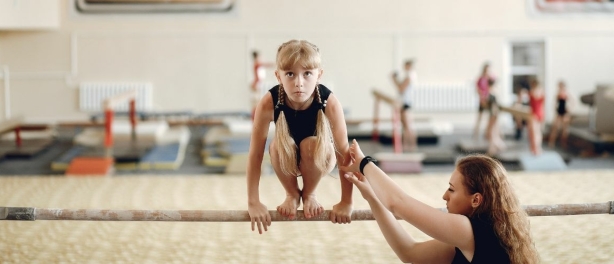
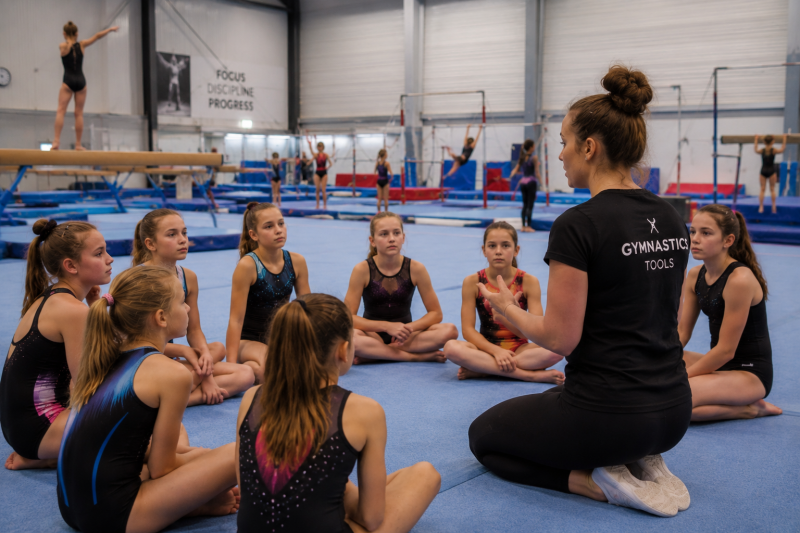
Example of a lesson setup where multiple gymnasts stay active at the same time.
Better lessons often create faster progress than extra hours
A lot of improvement starts with asking different questions as a coach.
Not:
“Do we need to train more?”
But:
“How can we get more out of the training time we already have?”
Because small improvements inside the lesson itself often create massive results over time.
Less waiting.
Shorter explanations.
Smarter stations.
Clearer progressions.
More independent practice.
Those things may seem small individually, but together they completely change the intensity and effectiveness of a lesson.
Especially in recreational gymnastics, where coaches often work with:
- large groups
- mixed levels
- limited assistants
- limited preparation time
Structure becomes everything.
When the lesson flows better, gymnasts stay engaged longer. When gymnasts stay engaged longer, they get more quality repetitions. And when repetitions improve, progress usually follows naturally.
Creativity often matters more than expensive equipment
A lot of coaches think they need more equipment to improve the level of their group. But often, the biggest gains come from using existing material more intelligently. Not necessarily more material. Just smarter setups. That is where creativity becomes incredibly valuable as a coach.
Mattresses can become technical training tools
Most coaches see mattresses as safety material. But they can also make skills more approachable, safer to repeat, and easier to practise independently. That immediately changes lesson intensity. Because when gymnasts feel safer, they usually dare to repeat a movement more often.
And more confident repetitions almost always lead to faster progress.
Small materials can completely change a lesson
Some of the most useful coaching tools are also the simplest ones.
Pawns, hoops, elastics, ropes, foam blocks — they all help create clearer movement tasks and more visual learning. And visual learning matters enormously in gymnastics.
Because gymnasts often understand movement faster when they can see or feel the task instead of only hearing another explanation.
That means:
- less overexplaining
- less confusion
- more active time
- more independence
Which is exactly what many coaches need in busy lessons.
Pawns
Pawns are incredibly useful for structure and direction. You can use them to guide movement lines, create challenges, organise stations, or improve spatial awareness. Especially in larger groups, they help gymnasts work more independently without constantly needing the coach beside them.
Hoops
Hoops are one of the most versatile materials in gymnastics. They can help with rhythm, positioning, direction, distance, and body awareness. And because the task becomes visual immediately, gymnasts usually understand the exercise much faster.
That saves an enormous amount of explanation time.
Elastics
Elastics are one of the strongest tools for technical feedback. A gymnast often feels an elastic correction much faster than they understand a verbal one. That makes learning more intuitive.
Instead of constantly repeating:
“tighten your shape”
or
“open your shoulders”
…the gymnast can physically experience the correct movement.
That changes the learning process completely.
Smarter setups create more independence
One of the biggest hidden problems in gymnastics lessons is dependency. If every repetition requires the coach, the lesson automatically slows down.
That means:
- more waiting
- fewer repetitions
- less observation time
- less coaching overview
And for coaches working alone, that becomes exhausting very quickly.
That is why smart setups matter so much.
A simple example is the homemade bucket turn chair. Instead of needing constant coach support for every attempt, gymnasts can practise more independently and build confidence through repetition.
Another great option is practising the hip circle with the gymnast’s feet supported in rings hanging from the bar. This gives gymnasts extra support and helps them experience the movement more successfully and with less fear.
Even something as simple as a strap or ribbon attached to the bar can function as a basic bucket turn support tool and create many more opportunities for independent practice.
And that creates something every coach wants:
More active gymnasts at the same time.
Sometimes the biggest improvements happen around the exercise
A lot of coaches focus heavily on exercises themselves.
But gymnast development is also shaped by everything surrounding the exercise.
The organisation.
The transitions.
The station flow.
The clarity of the task.
The speed of setup changes.
Those things quietly determine how much actual learning takes place during a lesson.
And over months of training, the impact becomes huge.
Coaches often explain too much
This is extremely common. Not because coaches are bad at coaching.
Usually the opposite.
They care. They want to help. They want gymnasts to fully understand the movement.
But long explanations often create the opposite effect.
Gymnasts stop listening. Energy drops. The lesson slows down.
Meanwhile, the gymnast usually learns most during movement itself.
That is why shorter explanations are often more effective.
Clear.
Simple.
Direct.
Then let the gymnast experience the movement.
Observation is one of the most underrated coaching skills
Many coaches spend the entire lesson reacting.
Correcting.
Spotting.
Setting up.
Managing behaviour.
Fixing problems.
And when that happens constantly, it becomes difficult to really observe what is happening. But observation is where coaching quality often increases the most. Because when you truly watch carefully, you start seeing:
- where movement breaks down
- where fear appears
- where understanding disappears
- where attention drops
- where the progression is too big
And those insights help you coach much more effectively. Sometimes better coaching starts with slowing yourself down enough to actually see what your gymnasts need.
Better preparation creates calmer lessons
Experienced coaches sometimes prepare less because they already know so many exercises. That makes sense. But even experienced coaches benefit enormously from structure. Because preparation is not only about knowing exercises.
It is about:
- creating flow
- reducing chaos
- building logical progressions
- keeping intensity high
- reducing wasted time
And that is exactly why ready-made lesson structures and progressions can be so valuable. Not because coaches are lazy. But because constantly reinventing lessons takes enormous energy. Especially when coaching is combined with:
- work
- school
- study
- multiple training groups
That pressure is real for many coaches.
👉 This is exactly why many coaches use Gymnastics Tools: to save preparation time while still delivering structured, high-quality lessons.
Motivation changes everything
A gymnast who is mentally engaged learns differently. That is why motivation is such a powerful factor in long-term progress. When lessons become repetitive, predictable, or passive, gymnasts slowly disconnect. And once engagement drops, learning slows down too. That is where variation becomes important. Not random variation. Purposeful variation.
Different training forms.
Different challenges.
Different movement situations.
Different ways of learning the same skill.
That is also why concepts like differential learning work so well in gymnastics. They keep gymnasts mentally involved instead of mechanically repeating movements without attention.
Simple tools can massively improve learning
Some of the best coaching tools are incredibly inexpensive.
Insulation tubes
Insulation tubes from the hardware store are one of the best examples.
Cheap.
Easy to carry.
Extremely visual.
They can help indicate:
- body direction
- movement lines
- jump distance
- hand placement
- posture
And because the feedback becomes visual immediately, gymnasts often understand the task much faster.
Recreational classes with creative setups
Especially in recreational gymnastics, small setup changes can completely transform lesson quality.
By combining pawns, hoops, benches, foam blocks, or small challenges, even simple stations become more engaging.
Gymnasts stay active longer.
They think more independently.
And the lesson instantly feels more dynamic.
Elastics are incredibly powerful for technical awareness
One of the biggest advantages of elastics is that they help gymnasts feel movement instead of only thinking about movement. That difference matters.
Because many technical corrections are difficult to understand verbally. But when a gymnast physically experiences correct shaping or resistance, learning becomes much faster. That makes elastics useful for:
- shaping drills
- swing direction
- posture
- body tension
- movement awareness
And because the exercises often feel more interactive, gymnasts usually enjoy them more too.
Stop thinking in apparatus — start thinking in movement patterns
A lot of coaches immediately think:
“We need another bar.”
But often, what actually improves progress is not more apparatus. It is better training forms. That mindset shift changes everything. Because once you start thinking in movement patterns instead of equipment labels, your options become much bigger.
Ropes
Ropes can help make movement goals visual and clear.
You can use them for:
- body direction
- height targets
- shaping
- swing pathways
And visual targets almost always improve understanding faster than verbal corrections alone.
Blocks
Blocks create visible challenges. And visible challenges are often much easier for gymnasts to respond to naturally.
Instead of repeatedly saying:
“Jump higher.”
…the gymnast simply sees the target.
That changes behaviour much faster.
Jumping rope on the beam
This is a great example of playful learning improving focus. When gymnasts become too focused on fear or perfection, adding a playful external task can completely shift attention. And sometimes that shift alone improves movement quality immediately.
Using the plankoline differently
Many coaches only use a plankolin one way. But creative coaching often starts when you stop seeing equipment as fixed-purpose material. One setup can support many different movement patterns and progressions.
And that flexibility creates much more variety inside the lesson.
Even old equipment can become valuable again
Sometimes useful coaching tools are already sitting in the storage room.
Unused.
Forgotten.
Ignored.
But when you look at equipment through a coaching lens instead of an equipment label, new possibilities appear.
That happened with an old horse that initially just felt like something taking up space.
Until it became part of a progression setup that suddenly allowed more successful repetitions and more confidence.
The best coaches keep looking for possibilities
A lot of clubs struggle with:
- limited budgets
- limited space
- limited equipment
- limited coaching support
Those challenges are real.
But the coaches who keep improving are often the ones who continue looking for possibilities inside those limitations.
They think creatively.
They optimise setups.
They simplify lessons.
They improve organisation.
They create smarter progressions.
And over time, those small improvements create massive differences in gymnast development.
Final thought
If your gymnasts are not improving the way you hoped, it does not automatically mean:
- your athletes lack talent
- your lessons are failing
- or you need dramatically more training hours
Very often, the answer is much simpler.
Better structure.
Better flow.
Better organisation.
Better progressions.
More engagement.
More meaningful repetitions.
That is where long-term progress is usually built. And that is exactly what Gymnastics Tools is designed to support. Not just by giving coaches more drills.
But by helping coaches create lessons that feel:
- calmer
- clearer
- more effective
- and much easier to build consistently
Because sometimes the fastest way to improve your gymnasts…
is to first improve the system behind your coaching.