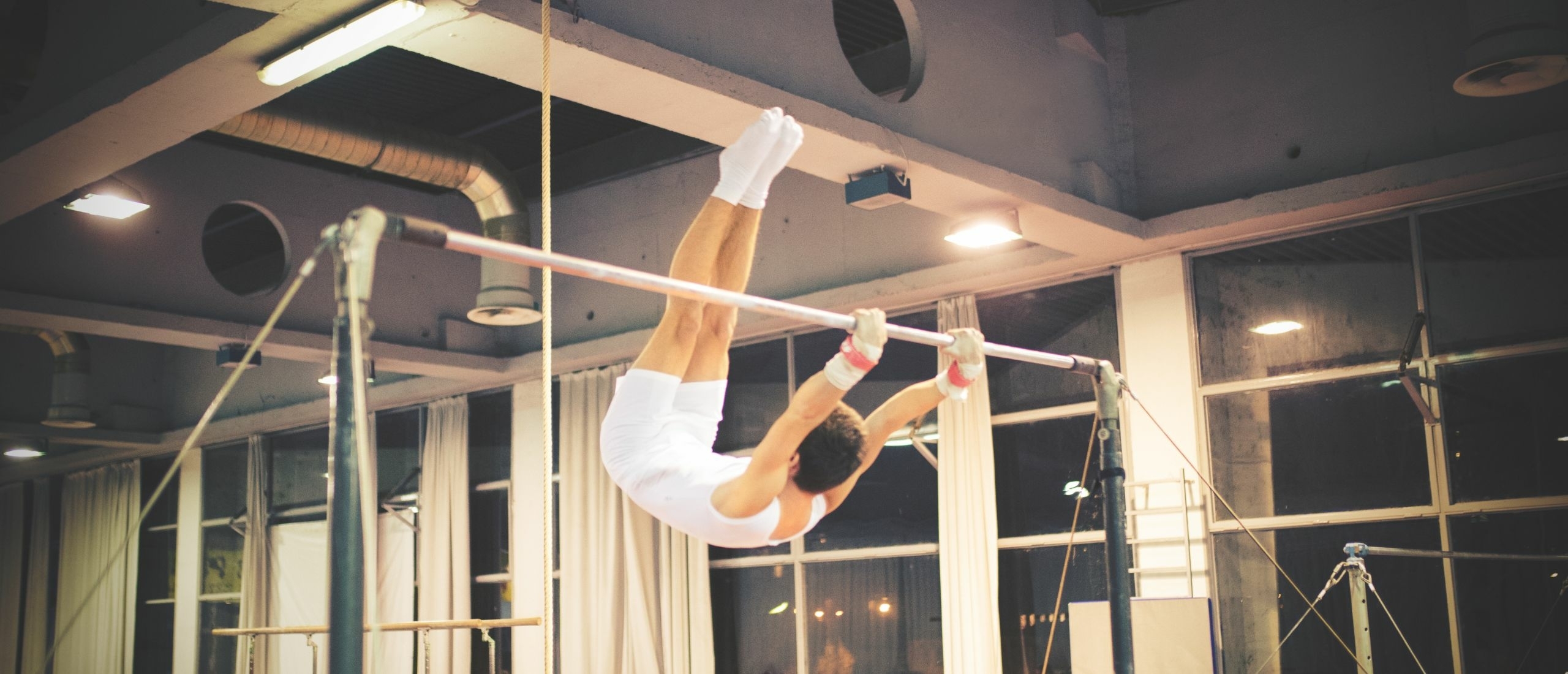

The baby giant is a gymnastics element on the uneven bars and the high bar. For many gymnasts, this skill is the stepping stone toward performing a full giant. Technically, the baby giant is a complex swinging element in which timing, strength, shoulder mobility, and core tension must work together perfectly.
In this blog, we explain step by step what the baby giant is, which phases it consists of, which physical prerequisites are needed, how to build it up methodically, and how coaches can give effective technical cues.
What is a baby giant?
The baby giant is a swinging movement on the bar in which the gymnast rotates backward around the bar but does not complete the full circle as in a full giant. The movement ends in a controlled front support on the bar.
The baby giant is commonly used as preparation for the full giant, as a connecting element in bar combinations, and to move into front support on the high bar from a swing.
What does the baby giant look like?
In this blog, we focus on the basic baby giant performed from a swing.
The gymnast starts from the backswing in a hang on the bar. From this swing, the body moves backward around the bar while the shoulders actively open and the body swings upward. The movement is finished in a controlled support position on the bar.
Key characteristics of a good baby giant are straight arms, closed and straight legs, active core tension, and an open shoulder angle with the arms next to the ears.
The baby giant in phases
Like many gymnastics skills, the baby giant can be divided into phases. This makes the element clearer and easier to teach.
1. initiation phase – swing
The movement starts from the swing on the bar. The gymnast comes out of the front swing and immediately initiates a powerful backswing, keeping the body long while the shoulders actively move with the swing.
The body stays extended, the arms remain straight, the shoulders move actively, and the core stays engaged. The goal of this phase is to build rhythm and timing.
2. backswing phase
After the front swing, the gymnast swings backward under the bar. The body stays long and tight, with the legs closed and a slightly rounded body position. This phase lays the foundation for height and rotation later in the skill.
3. opening phase – shoulder opening
As the body rises behind the bar, the shoulders must open fully. The arms stay next to the ears, the shoulder angle opens as much as possible, and the gymnast avoids compensating by arching the lower back.
This is a crucial phase where many technical errors occur. When executed correctly, the body remains long, tight, and ready to convert swing into upward motion.
4. hang and kick (tap) under the bar
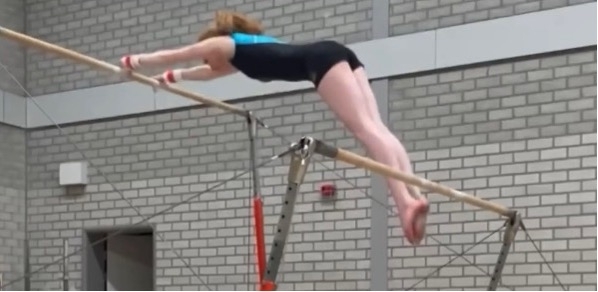
In this phase, the gymnast converts the active hang under the bar into the kick action toward support. The legs kick actively upward while staying closed and straight. The swing is transformed into height through shoulder pressure, and core tension is maintained.
The quality of this phase largely determines whether the gymnast can actually move toward support.
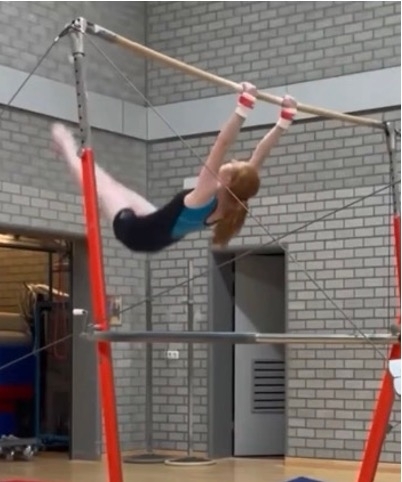
5. rotation phase
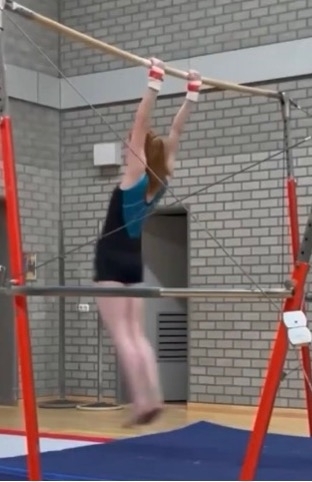
During the rotation phase, the gymnast rotates backward around the bar, rotating around the transverse axis. Core tension must be maintained, the head stays neutral, and the timing of the kick action is essential. Losing tension or throwing the head back often disrupts the rotation.
6. final phase – support phase
The baby giant finishes in a front support on the bar. The gymnast swings up above the bar and absorbs the movement in a controlled support position. The arms stay straight, the shoulders remain active, and the core stays engaged. This phase clearly shows whether the energy and timing from earlier phases were carried through correctly.
physical requirements for the baby giant
Without the right physical foundation, it is almost impossible to learn a technically correct baby giant. Shoulder mobility and core tension are especially important.
Adequate shoulder mobility allows the gymnast to open the shoulders without compensating by bending the arms or arching the lower back. Active flexibility is key here: not just stretching, but learning to control the end range of motion.
Core tension is required throughout the entire movement. The abdominal muscles, lower back, and glutes must stay engaged to prevent the swing from collapsing and to preserve energy. Without sufficient core tension, the gymnast loses speed and height and cannot finish the skill effectively.
Arm and shoulder strength are also essential. The gymnast must be able to support and control their own body weight. Weak shoulders often result in bent arms, unstable support, and a lack of control in the final phase.
Grip strength plays an important role as well. Insufficient grip strength can lead to insecurity, early release of the bar, and reduced confidence during the swing.
building up the baby giant
In gymnastics, skills are almost never learned all at once. A step-by-step approach is essential.
step 1 – swinging
A technically sound swing is the foundation of the baby giant. A good swing allows the gymnast to generate height, rotate smoothly around the bar, and finish in a controlled support position.
Effective exercises include front and back swings in hang with a focus on length and rhythm, swings with closed legs, swings with a brief pause in the backswing to develop body awareness, and swings with counted rhythm for timing.
step 2 – training shoulder action
The shoulders play a key role in the baby giant. Active shoulder opening helps direct the body upward during the backswing and prevents the swing from losing energy under the bar.
Exercises may include hanging swings with active shoulder movement, swings emphasizing shoulder opening, shoulder mobility drills on stall bars, and swings with a brief stop in an open shoulder position to develop feeling and control.
step 3 – kick action and lift toward support
In this step, the focus is on the active leg kick and the upward push through the shoulders. The kick adds speed and height and helps complete the rotation toward support.
Useful exercises include swings with an emphasized kick in the backswing, swings focusing on leg closure and kicking action, swings combined with a partial lift toward support, and practicing the kick from a low or assisted starting position.
step 4 – baby giant with assistance
With spotting, the gymnast can experience the full movement to support and develop confidence. The coach may assist at the shoulders and lower back or guide the rotation at the upper legs, always moving with the gymnast and guiding rather than pulling.\
step 5 – independent execution
The gymnast performs the baby giant independently when shoulder opening is sufficient, core tension is stable, and timing is correct. At this stage, swing, kick, and shoulder action come together in a controlled finish in support.
Technical cues per phase
In the initiation phase, the gymnast should stay long in the swing and actively carry their body, with engaged core muscles and moving shoulders. During the backswing, maintaining tension is essential: legs stay closed, hips do not collapse, and the swing remains long.
In the kick phase, the legs actively accelerate the movement upward, reinforcing the swing. During the lift and rotation toward support, the gymnast pushes the bar away, opens the shoulders, and maintains full-body tension until reaching support.
In the final support phase, the gymnast stays strong and active, with straight arms and engaged shoulders, finishing the movement in control.
Common mistakes in the baby giant
Common mistakes include bending the arms, often caused by insufficient strength or insecurity, collapsing in the hips due to lack of core tension, and closed shoulders caused by limited mobility or fear.
Another frequent issue is insufficient height, usually related to poor timing or an inactive kick rather than a lack of strength. Some gymnasts stop rotating too early, often due to fear, resulting in an incomplete and unstable finish.
Identifying the phase in which the mistake occurs helps coaches target training more effectively.
Spotting the baby giant
Spotting is often needed during the learning process, especially to support the kick, lift, and rotation toward support. Effective spotting focuses on safety, confidence, and guiding the movement rather than forcing it.
Coaching and feedback
Instead of vague cues, specific and functional feedback helps gymnasts understand what they are doing. Clear feedback about shoulder position, core tension, and arm use makes learning more effective and builds confidence.
Conclusion
The baby giant is a key element in bar gymnastics development. It requires a strong combination of strength, timing, tension, and confidence. By breaking the skill into clear phases and training it methodically, gymnasts gain structure and understanding.
Targeted feedback and well-chosen exercises help gymnasts progress step by step toward a strong and controlled baby giant, while also building a solid foundation for learning the full giant.
For more in-depth explanations, practical drills, and tools you can apply directly in your lessons, visit Gymnastics Tools.